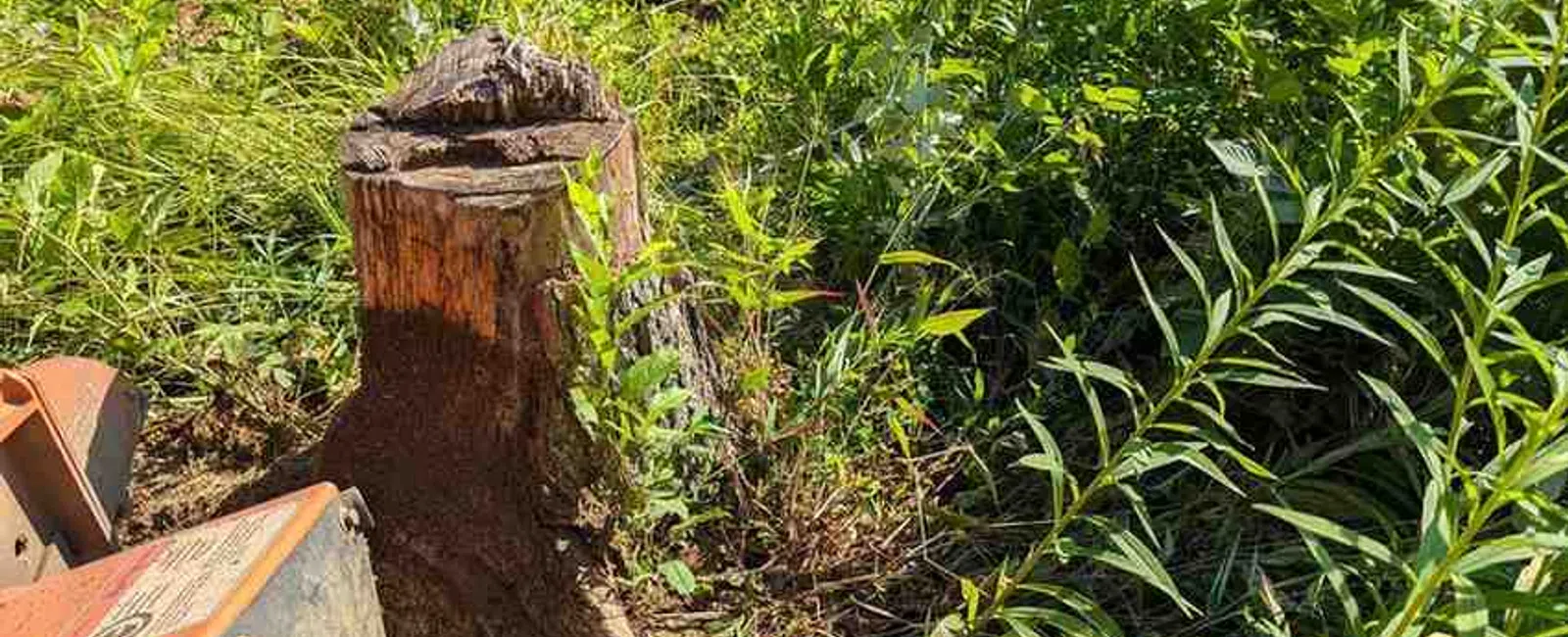
A bush stump is harder to pull than its size suggests because most yard shrubs hold on with a dense mat of lateral roots rather than a single taproot. Privet, forsythia, and burning bush, three of the most common hedge plants in Southwest Virginia yards, also resprout from any root left in the ground, so cutting them flush and walking away usually means a new thicket by the following summer. The right removal method depends on the shrub species, how long it has been in the ground, and what the spot needs to become once the stump is gone.
Why Bush Stumps Fight Back
Shrub roots fall into two patterns. Boxwood, azalea, yew, and most evergreen foundation plants grow a shallow, fibrous root ball that spreads wider than the plant itself. These stumps lift out once the outer roots are cut, but the root ball holds a surprising amount of soil, which is where the weight comes from. Privet, forsythia, lilac, rose of Sharon, and holly grow a woody crown with thick lateral roots that run out two or three feet and then dive. Holly in particular sends down an anchor root that does not want to come up with the rest of the plant.
The second problem is the crown. The swollen base where the stems meet the roots is covered in dormant buds, and on privet, forsythia, burning bush, and multiflora rose those buds wake up as soon as the top growth is removed. A hedge that was cut to the ground in March can be waist high again by August. Any method that leaves the crown alive is a trimming job, not a removal.
Soil matters too. The red clay across the region grips roots tightly when it is dry and turns to suction when it is wet. Digging a day or two after a soaking rain, when the clay is damp but not sloppy, is noticeably easier than working it in either extreme.
Digging Out a Small Shrub Stump by Hand
Hand removal works on shrubs with a base under about three inches across, planted within the last several years, in soil that has not been compacted by foot traffic or a driveway. A mattock, a pair of loppers, and a root saw cover nearly every job in that range.
- Cut the top growth back to a stub 12 to 18 inches tall. A stub gives you something to rock and lever against. Cutting flush removes the only handle you have.
- Dig a trench about a foot out from the crown, all the way around, until the lateral roots are exposed.
- Cut each lateral root with loppers or the root saw as you find it. A mattock handles both the digging and the cutting on roots up to an inch thick.
- Rock the stub in every direction to find what is still holding, cut that root, and lift the crown out.
On a mid-size shrub, a high-lift farm jack with a chain wrapped around the stub does the final pull without wrecking your back. Chaining a stump to a truck bumper is a different story. The roots snap off below grade instead of coming out, the crown stays in the ground with its buds intact, and chains under that kind of load fail without warning.
Cut-Stump Treatment for Shrubs That Resprout
For privet, forsythia, burning bush, autumn olive, and multiflora rose, the cut-stump method kills the crown so it cannot regrow, even though the stump itself stays in the ground. The shrub is cut as low as possible, and a concentrated brush killer labeled for cut-stump application is painted onto the outer ring of fresh wood right away, before the cut surface seals. The outer ring is where the plant moves sap, so that is where the product travels down into the roots.
Timing changes the result. Late summer through early fall is the strongest window because the plant is pulling sugars down into the roots for winter and carries the treatment with them. Spring applications, when sap is moving upward, are far less reliable. Always follow the product label for mixing and application, and keep the treatment off the soil and away from the roots of plants you want to keep, since shrubs in a hedge row often share root space.
A treated stump dies in place and rots over several years. That is fine behind a shed or along a back fence. It is not fine in a bed that is being replanted next month, which is where grinding comes in.
Grinding Bush Stumps and Hedge Rows
A stump grinder solves the problems the other methods leave behind. The cutting wheel chews the crown and the first few inches of lateral roots down below grade, which removes every dormant bud at once. There is nothing left to resprout and nothing left to rot. Standard stump grinding takes each stump below the surface and leaves the grindings piled on the spot or raked out around it.
Grinding is the right call in a few specific situations:
- A full hedge row of established privet, boxwood, or holly, where digging twenty crowns by hand would take a weekend and leave a trench the length of the yard.
- Shrubs planted tight against a foundation, porch, sidewalk, or fence line, where swinging a mattock risks the footing drain, the fence posts, or the concrete.
- Old shrubs with a base of four inches or more, especially holly and lilac, whose anchor roots do not come out by hand without a backhoe.
The sequence matters when the hedge is still standing. A grinder works on stumps, not on eight feet of tangled growth, so an overgrown hedge row gets cut down first. Brush cutting work handles that stage along property lines and fence rows, and the cut material can go to a pile for brush clean up and hauling so it is not sitting in the yard while the stumps are dealt with.
Filling the Hole and Replanting
Once the stump is out, the hole fills with topsoil mounded an inch or two above grade, since the fill settles over the first few rains. If the spot was ground rather than dug, the grindings mixed in the hole will keep settling for a year or more as the wood chips break down. For a new shrub going in right away, pulling most of the grindings out and backfilling with clean soil avoids a plant that sinks over time. For a lawn patch, mixing in a thinner layer of grindings is harmless, though decomposing wood ties up nitrogen for a season and grass fills in slowly until it balances out.
The first growing season after any shrub removal, walk the spot every couple of weeks and pull or mow any shoots that appear. Young suckers come out of damp soil with a hand tug. Suckers left until they harden off have rebuilt a root system and are back to being a stump problem.
Bush Stump Removal Across Southwest Virginia, Northeast Tennessee, and Western North Carolina
We grind shrub stumps and hedge rows the same way we handle tree stumps, below grade and with the crown fully removed so nothing comes back. Overgrown hedges that need cutting first, piles that need hauling, and single stumps in a tight spot next to the house are all jobs we take on. Call 276.477.4240 or request a free estimate, and we will let you know how fast we can get to you.